
May 2026
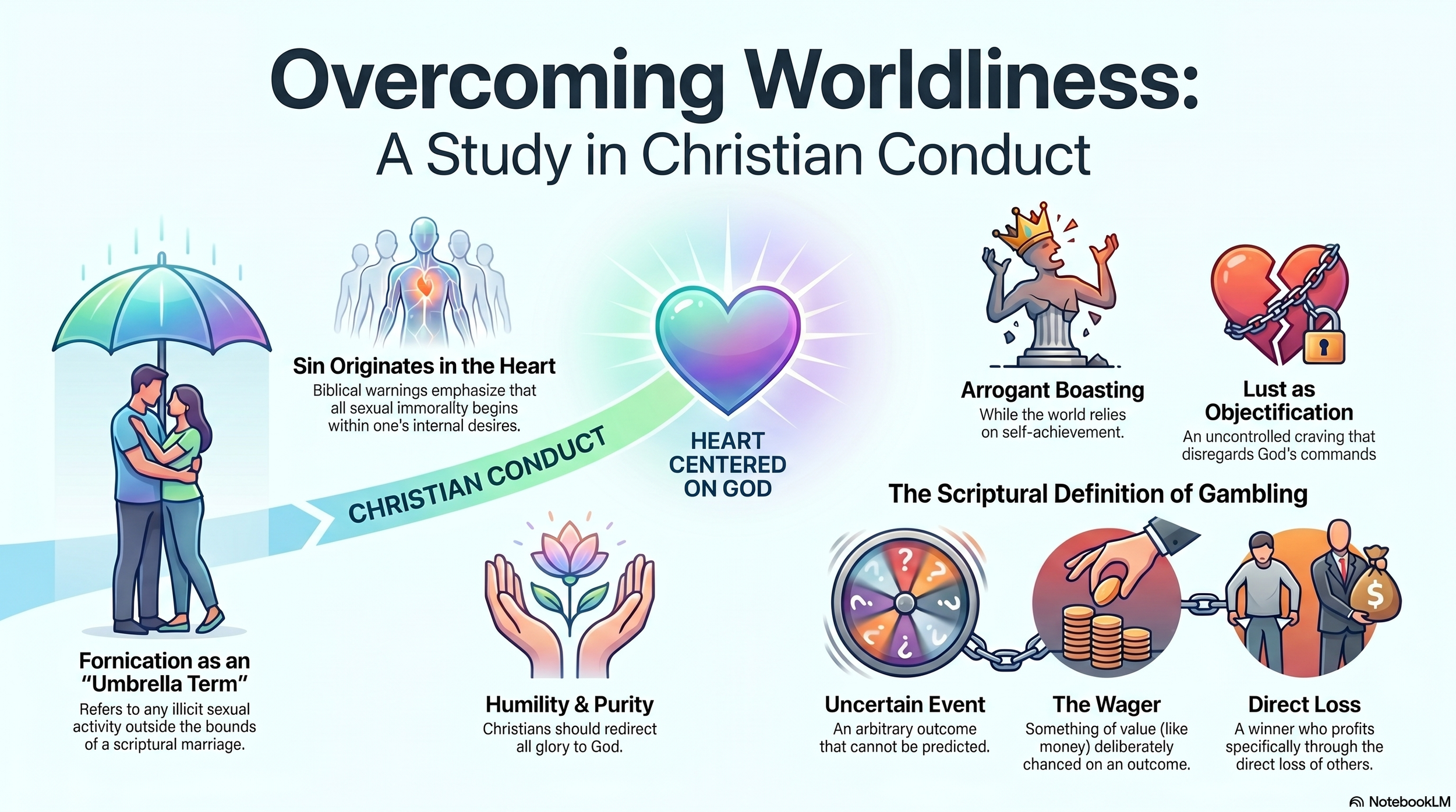
Overview
- Continuing a multi-session study on worldly practices; finalizing gambling topic.
- Eldership consulted on specific questions; congregation autonomy respected.
- Class moved from gambling to topics: lustfulness, fornication, boasting.
- Emphasis on identifying worldliness and avoiding practices contrary to Scripture.
Gambling: Hope Scholarship Question
- Question: Is it wrong for a student to accept a Tennessee HOPE scholarship tied to the state lottery?
- Elders' conclusion: Accepting the scholarship is not considered sinful.
- Reasoning:
- Gambling defined by three elements: uncertain arbitrary event; wager of value; winner gains at direct loss of a loser.
- Scholarship award does not meet these three elements despite lottery origin.
- Clarifications:
- Elders still do not endorse gambling generally.
- Some members remain uneasy about accepting proceeds originating from gambling.
- Further study or elder involvement may be pursued for clarity.
Worldliness: Purpose Of The Study
- Objective: Identify worldly practices and avoid them.
- Examples listed for future study:
- Lustfulness, boasting, fornication, inappropriate clothing, bullying, gossiping, fighting, conniving, deception, drug abuse, idolatry, quarreling, denominationalism, racism, road rage, poor friendships, dancing, condoning abortion, smoking.
- Guiding principle: If a Bible principle is violated, repentance is required.
Lustfulness
- Definition: Intense, uncontrolled craving typically for sexual pleasure; also passionate craving for forbidden things.
- Relation to covetousness: Lust is a sexualized form of covetous desire.
- Characteristics:
- Objectifies others; can apply beyond sexual contexts (sports figures, politicians).
- Disregards God’s commands.
- Key Scriptures:
- 1 John 2:16 — lust belongs to the world.
- Matthew 5:28 — lustful looking equates to adultery in the heart.
- Galatians 5:16 — walk in the Spirit to avoid fleshly lusts.
- 2 Timothy 2:22 — flee youthful lusts; pursue righteousness.
- 1 Peter 2:11 — abstain from fleshly lusts.
- Romans 13:14 — make no provision for fleshly lusts.
- Conclusion: Lustfulness is a worldly practice Christians must resist.
Fornication (Sexual Immorality)
- Definition: From Greek porneia; umbrella term for illicit sexual activity outside scriptural marriage.
- Forms listed: premarital sex, prostitution, incest, homosexuality, adultery, bestiality, rape.
- Observations:
- Fornication is widespread and normalized in the world.
- God created sexual expression for good but confined to marriage.
- Christians must guard hearts, minds, and bodies; avoid introducing fornication into the church.
- Key Scriptures:
- 1 Thessalonians (sanctification): abstain from sexual immorality.
- 1 Corinthians 6:18 — flee sexual immorality; it is a sin against one’s body.
- Galatians 5:19–21 — sexual immorality is a work of the flesh.
- Hebrews 13:4 — God will judge fornicators.
- 1 Corinthians 7:2 — better to marry than to fornicate.
- Matthew 15:19 — sexual immorality originates in the heart.
- Colossians 3:5 — put fornication to death.
- Revelation 21:8 — fornicators among those judged to the lake of fire.
- Conclusion: Fornication is a sinful worldly practice requiring practical avoidance and repentance.
Boasting
- Definition/Issue: Arrogant boasting rooted in pride and self-reliance rather than dependence on God.
- Biblical teaching:
- James 4:16 — arrogant boasting is evil.
- Ephesians 2:8–9 — salvation is a gift; not a basis for human boasting.
- Jeremiah 9:23–24; 1 Corinthians 4:7; Proverbs 27:1–2; 2 Corinthians 10:17–18 — various warnings to boast only in the Lord.
- Practical points:
- Boasting appears through speech, texts, emails, social posts, and behavior.
- Distinguish righteous boasting (glorifying God, boasting in weakness) from arrogant self-boasting.
- Meekness is not weakness; Christians may state achievements factually while giving glory to God.
- Consider audience and context; boasting to those less fortunate can be hurtful.
- Motive determines whether acknowledgment of accomplishment becomes sinful boasting.
- Application:
- Redirect praise for achievements to God.
- Maintain humility and gratitude while honestly recognizing personal contributions.
Action Items
- Eldership follow-up: Consider further study or clarification about accepting funds derived from gambling.
- Continued study schedule: Next session to resume with boasting discussion and additional worldly practices listed.
Decisions
- Elders’ decision recorded: Receiving the HOPE scholarship is not considered sinful by the local eldership.
- Congregational stance reinforced: Gambling as an activity is not endorsed by the elders, despite the scholarship ruling.
Structured Summary
| Topic | Main Point | Scriptural/Practical Notes |
|---|---|---|
| Gambling (HOPE scholarship) | Accepting award not sinful per elders | Scholarship lacks key gambling elements; elders still oppose gambling generally |
| Lustfulness | Intense uncontrolled craving; objectifies others | 1 John 2:16; Matt 5:28; Gal 5:16; flee and mortify fleshly lusts |
| Fornication | Sexual activity outside scriptural marriage; multiple forms listed | 1 Cor 6:18; Heb 13:4; Col 3:5; Rev 21:8; Christians must abstain and guard themselves |
| Boasting | Arrogant boasting is sinful; boast only in the Lord | James 4:16; Eph 2:8–9; 2 Cor 10:17–18; maintain humility and gratitude |
Avoiding Worldliness Quiz
Gambling, Lustfulness, Fornication, and Boasting
Barry’s Bureau Learning Check
“The object of this study is to identify worldliness and to avoid the practice of such.”
This 7-question quiz will help you review key ideas from the class and apply them with spiritual maturity.
Question 1 of 7
Quiz Complete
0%
Visit BarrysBureau.org for more Bible study resources.