
April 2026
IN THIS LESSON - April 29, 2026
Overview
- Topic: Identifying and avoiding worldliness, with focus on gambling as a worldly practice.
- Purpose: Reaffirm biblical principles that distinguish Christians from worldly behavior and evaluate gambling against those principles.
- Setting: Group teaching/discussion with questions and participant comments.
Key Biblical Points
- Worldliness defined by several New Testament warnings: love of the world, lusts of flesh and eyes, pride of life.
- Relevant scriptures cited:
- 1 John 2:15 — Do not love the world or things in it.
- Romans 12:2 — Do not be conformed to this world; be transformed.
- John 17:14–16 — Believers are not of the world.
- 2 Timothy 2:4 — A soldier avoids entanglement with life affairs.
- Luke 12:15; Colossians 3:5; Exodus 20:17; Ephesians 5:5 — Warnings against covetousness, equated with idolatry.
- 1 Timothy 5:8 — Provide for household; neglect is denial of faith.
- Philippians 4:19; 1 Corinthians 10:13; Psalm 56:3; Proverbs 3:5–6 — Trust God for needs and deliverance.
Gambling: Definition And Criteria
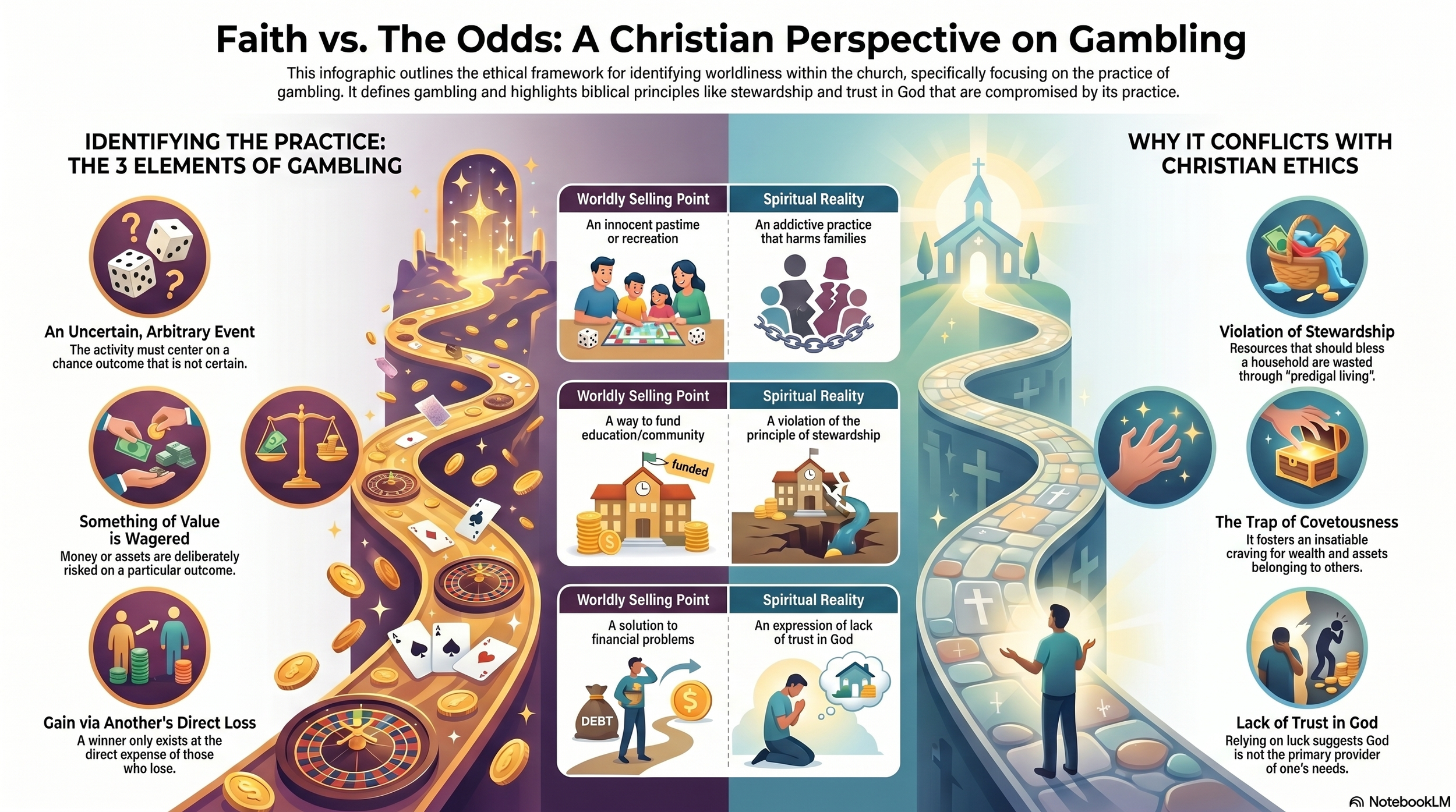
- Three required elements for an activity to be gambling:
- An uncertain, arbitrary event (chance).
- A wager of something of value (usually money).
- A winner gains directly at the loss of losers.
- Common forms discussed:
- Lotteries, casinos, sports betting, horse/dog/animal races, bingo, electronic/online games, private/house betting.
- Distinction made between competition/prizes and gambling:
- Competitions with prizes are not inherently gambling unless all three criteria are met.
- Investments and insurance do not meet gambling criteria (no arbitrary outcome or winners at others' expense).
Problems And Principles Violated By Gambling
- Covetousness and greed:
- Gambling fosters desire for another’s possessions and idolizes wealth.
- Poor stewardship:
- Monetary resources are often wasted; funds lost could have supported family needs.
- Lack of trust in God:
- Relying on gambling to solve financial problems shows distrust in divine provision.
- Addiction and harm:
- Gambling is highly addictive; closest family members suffer most.
- Winners often become driven for more; losers chase losses.
- Community and social impact:
- Introduction of casinos/lotteries often accompanied by increased crime and community harm.
- Church opposition to gambling can attract political and social backlash.
Discussion Points And Questions Raised
- Casual/“for fun” betting (e.g., golf hole-in-one prize, bingo gift cards) debated:
- Even “for fun” participation can meet gambling criteria and influence others.
- The heart/motivation matters; covetous intent or prioritizing gambling over God is central.
- Edge cases:
- Insurance and investments deemed not gambling because they lack arbitrary outcomes and do not rely on others’ losses.
- Scholarships or funds derived from lottery revenues (e.g., scholarships funded by gambling proceeds) raised as ethical questions for future discussion.
- Personal conviction and liberty:
- Romans referenced regarding disputable matters: hold personal convictions before God and avoid forcing them on others.
- Christians should avoid causing weaker believers to stumble.
Action Items
- Continue the discussion next session to conclude the examination of gambling and related cases (scholarship funding example).
- Encourage personal reflection on whether specific activities meet the three gambling criteria.
- Promote vigilance about influence and stewardship in personal, family, and church finances.
Decisions
- No formal decisions recorded; consensus toward caution and avoidance when gambling criteria violate biblical principles.
- Agreement that violation of any biblical principle requires repentance.
Avoiding Worldliness: Gambling
"I heard a man say one time that he looked for the church in the world and found the world in the church... The object of this study is to identify worldliness and to avoid the practice of such."
- Barry G. Johnson, Sr.
- Barry G. Johnson, Sr.
Question 1 of 7